Product Portfolio

AI Safety Products for Enterprise

Policy enforcement and audit for every AI interaction surface. Start with Central Policy Manager + Audit Server, then extend to AI Gateway, Secure AI Browser, or Browser Extensions.

Business Outcomes

  • Prevent risky prompts before submission without slowing teams down.
  • One policy model across browser, endpoint, and AI API surfaces.
  • Expand from a first team to org-wide coverage without re-architecting.

Policy + audit foundation

No product works without Central Policy Manager + Central Audit Server. Run locally for a single seat or centrally for thousands. Either way, this is the base layer that defines policy, coordinates enforcement, and defaults to metadata-only audit signals.

Central policy and audit illustration with lifecycle and signal flow cues.

Central Policy Manager + Central Audit Server

The governance foundation every enforcement product depends on. Author, version, and sign policies in one control plane, distribute them to gateway and browser surfaces, and capture metadata-only audit signals — no prompt content retained, no per-user profiling by default.

What it enables

Author, version, sign, and distribute policy from a single control plane to all connected enforcement surfaces

Best for

Security and compliance teams who need one source of truth for policy before AI adoption scales
Interaction-layer products

Mix and match based on where teams interact with AI day to day.

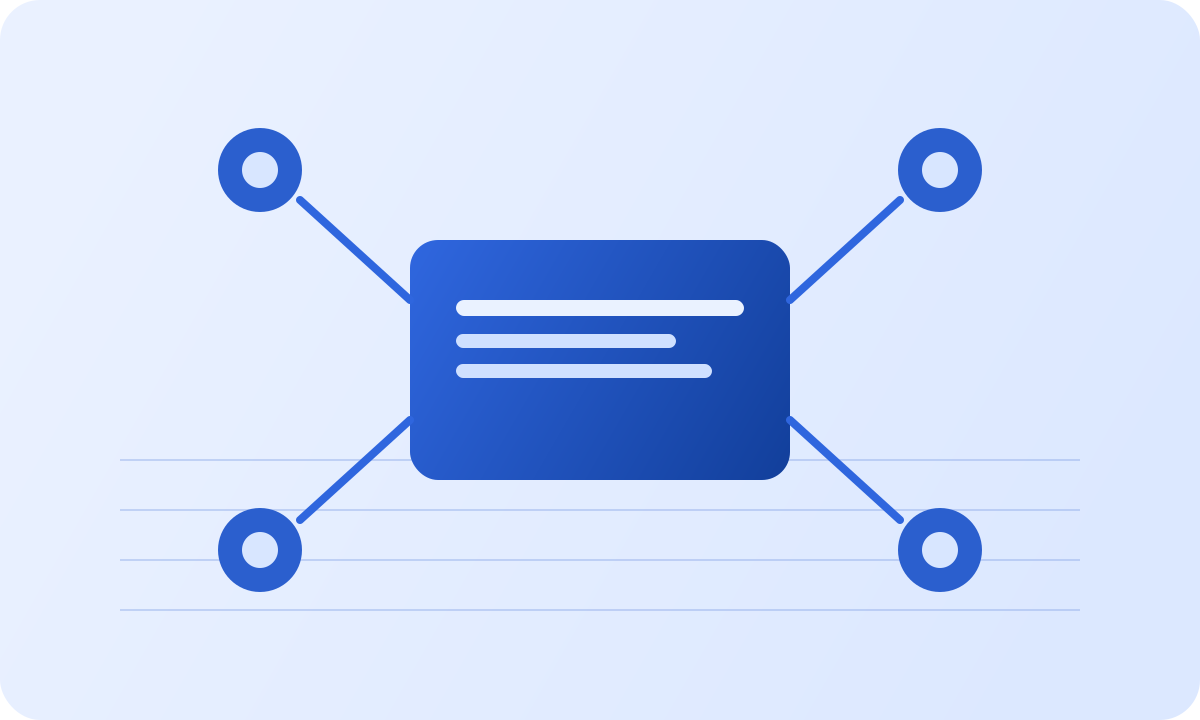
Diagram-style illustration of AI traffic moving through a central control gateway.

AI Gateway

Route AI requests from apps, IDEs, and API clients through a single policy checkpoint — deployed on-premise or in your VPC. Evaluate prompts before they reach external models, enforce data protection policy, and control model routing, fallback, and inference costs from one operational layer.

What it enables

Evaluate prompts at send-time across AI apps, IDE copilots, and API clients through one governed route

Best for

Organizations routing multiple AI tools through one enforcement and operational control point

Enterprise browser interface with a shield symbol that represents controlled AI browsing.

Secure AI Browser

Give AI work a dedicated, policy-controlled browser — separate from everyday sessions. Users interact with web AI tools in an approved environment where prompt-time enforcement, session isolation, and data boundary controls are active by default.

What it enables

Isolate AI web activity in a dedicated browser session with policy enforcement active by default

Best for

IT and platform teams establishing an approved, managed channel for web AI access

Browser extension coverage visual for rapid endpoint rollout.

Browser Extensions

Deploy prompt-time guardrails directly inside the AI web interfaces your teams already use. Browser Extensions add pre-submission enforcement — warn, redact, or block — at the endpoint, with no infrastructure changes and no new tools for users to learn.

What it enables

Intercept and evaluate prompts inside supported AI web interfaces before submission

Best for

Evaluation programs starting with a defined user cohort and needing governed AI coverage within days

Sovereign & Local AI Deployments

Governance-first deployment design

For organizations building private LLM stacks, local inference environments, or controlled agent frameworks, Skris provides governance-first design and validation for sovereign AI deployments.

We engage at architecture stage to define trust boundaries, policy enforcement points, and audit controls before systems reach production, ensuring AI operates within approved risk parameters from day one.

Designed for regulated and sovereign environments where jurisdictional control and audit defensibility are non-negotiable.

Scope includes

  • Alignment of local LLM inference with central policy
  • Agent execution boundary definition and control
  • Fine-tuning data governance validation
  • Sovereign deployment architecture and compliance review

Next step

Turn policy intent into enforceable controls across your AI stack.

Start with a technical brief for architecture review or launch a structured evaluation in your environment.